
Table of Contents:
- The Root Cause of Portfolio Management Dysfunction
- Pillar #1: Centralized Information Architecture
- Pillar #2: Real-Time Status and Reporting
- Pillar #3: Structured Workflows for Critical Processes
- Pillar #4: Portfolio-Level Analytics and Decision Support
- Why Platform-Based Portfolio Management Matters
- How VPO Enables Successful Portfolio Management at Scale
The early warning signs of portfolio dysfunction tend to show up in familiar ways. A report that used to take an hour now takes days. Critical documents frequently get lost in email threads. Teams start spending more time coordinating work than actually moving it forward.
After 40 years of working with construction professionals and owners, we’ve identified four pillars for portfolio management success. Together, these pillars provide a foundation for organizations looking to implement portfolio management processes and technology.
Below, we break down each pillar and explain how they work together to help organizations move from reactive oversight to confident, strategic portfolio management.
The Root Cause of Portfolio Management Dysfunction
As portfolio complexity increases, the challenges compound.
- Information silos develop across email, shared drives, and disconnected systems
- Managing multiple stakeholders across projects becomes a full-time job
- Teams spend hours building manual reporting and chasing updates
- Leadership confidence erodes as decisions rely on incomplete or outdated information
The Four Pillars of Successful Project Portfolio Management
Successful portfolio management starts by building the proper foundation for how information is organized, shared, and acted on. Let’s take a closer look at how each of these four pillars supports a more structured, scalable approach to portfolio management.
Pillar #1: Centralized Information Architecture
First, organizations need to establish a centralized information architecture.
This pillar is about providing a unified, single source of truth for all projects, both inside and outside the organization. Without it, real-time visibility is nearly impossible to maintain.
In many organizations, project information lives everywhere. Project managers maintain their own folder structures. Contractors use separate systems. And documents are emailed back and forth or stored in shared drives with little consistency.
Over time, no one is entirely sure where the most current information lives. This lack of visibility not only slows decision-making but also exposes organizations to unnecessary risk.
A centralized architecture gives everyone the information they need, with proper permissions, in a structured way.
Key Elements
- Single source of truth for all project information
- All stakeholders have access to the same data
- No version control issues or scattered files
- External collaborators access what they need
- Complete audit trail of all activities
VPO Client Example
One VPO client manages more than 150,000 drawings on a project. With VPO, their teams use metadata to quickly search for and find information, such as equipment type or facility area, rather than spending hours clicking through folders.
The Outcome: A Single Source of Truth
Everyone works in the same system. No more email attachments, searching through folders, or emailing to ask, “Who has the latest version?”
Centralization creates visibility and transparency. Everyone knows where to go. Everyone works from the correct version. And permissions ensure the right people see the right information.
Pillar #2: Real-Time Status and Reporting
Once information is centralized, real-time reporting becomes possible.
Real-time doesn't necessarily mean teams are live-streaming data every second. It means that when something changes, the system reflects it immediately. When a field report is submitted, an RFI is answered, or a change order is approved, teams can immediately access and act on that information.
This shift fundamentally changes how teams spend their time.
Instead of manually compiling reports at the end of the week or scrambling before a board meeting, teams have access to real-time data in seconds. Executives can ask questions and get answers without pulling high-value team members into last-minute reporting sprints.
Key Elements
- Data entered once, available immediately
- Automated reporting – no manual compilation
- Dashboards answer executive questions instantly
- Different views for different audiences
- Historical trending shows patterns over time
VPO Client Example
We have a utility client who presents to their board monthly. Before VPO, their team would spend a week preparing for that meeting – pulling data from multiple sources, creating slides, and double-checking numbers.
Now? They generate their board presentation directly from VPO in about 15 minutes. The data is current as of that morning, and the board has far more confidence in what they're seeing.
The Outcome: Visibility Transforms Decision-Making
Real-time visibility significantly reduces administrative burden and decision latency. Leaders spend less time requesting updates and more time focusing on proactive problem-solving. At the same time, managers get back 40+ hours per month by eliminating manual reporting.
Pillar #3: Structured Workflows for Critical Processes
Email is effective for communication, but it does not support critical project management workflows.
Every construction owner knows that managing RFIs and submittals is critical. And that delays in these processes have a direct impact on schedules and cost. When these processes live in inboxes, things get lost, response times vary, and accountability becomes difficult to enforce.
Structured workflows bring consistency and clarity.
Key Elements
- RFI submission, routing, tracking, and resolution
- Submittal review and approval workflows
- Change order request and evaluation
- Meeting minutes and action items tracking
- Automated notifications and escalations
VPO Client Example
After implementing VPO, one customer shared that their RFI response time went from an average of 14 days to 5 days. Not because their people worked faster, but because nothing got lost in email anymore. The platform kept every RFI visible, tracked response times, and automatically escalated items that exceeded their target timeframe.
The Outcome: Email Chaos Dies Here
Imagine when an RFI is submitted, it’s automatically routed to the right approver, tracked for response time, escalated if overdue, and closed with complete documentation. This level of control is what’s possible with effective process management supported by the right platform.
With structured workflows, accountability becomes built in, and teams regain time previously spent chasing responses.
Pillar #4: Portfolio-Level Analytics and Decision Support
The final pillar is where portfolio management becomes truly strategic.
Individual project status is important, but portfolio-level analytics let you see patterns.
Are we consistently underestimating certain types of projects? Do we have resource conflicts across multiple projects? Are specific contractors consistently delivering on time, while others aren't?
This level of insight drives better decision-making, planning, and continuous improvement. You're not just managing projects. You're optimizing your entire portfolio.
Best of all, portfolio-level analytics in VPO build on tools teams already use like Power BI. In today's saturated technology landscape, familiarity matters. When systems already align with existing workflows, it’s easy for teams to adopt a new approach and start seeing results quickly.
Key Elements
- Roll-up views across all projects
- Budget-to-actual variance tracking
- Resource allocation visibility
- Risk trending across the portfolio
- Performance metrics for continuous improvement
The Outcome: From Tactical to Strategic
As project volume increases, management shifts from tracking individual projects to optimizing the portfolio as a whole. Owners can see patterns, allocate resources more effectively, and drive performance at scale.
Why Platform-Based Portfolio Management Matters
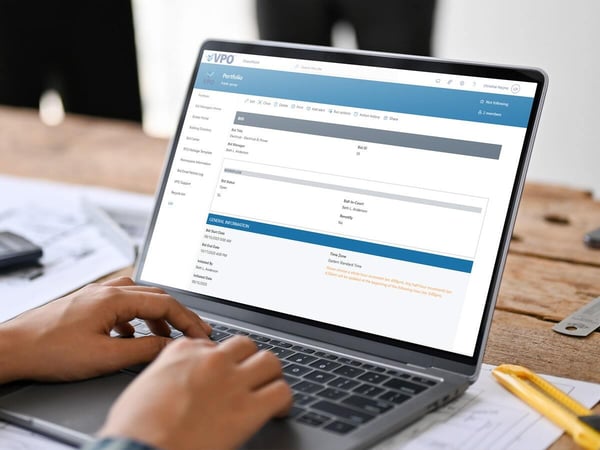 There is no shortage of project management tools on the market, but many standalone solutions introduce new challenges around IT approval and adoption. Tools may look compelling on paper, but struggle to fit cleanly into the systems organizations already rely on.
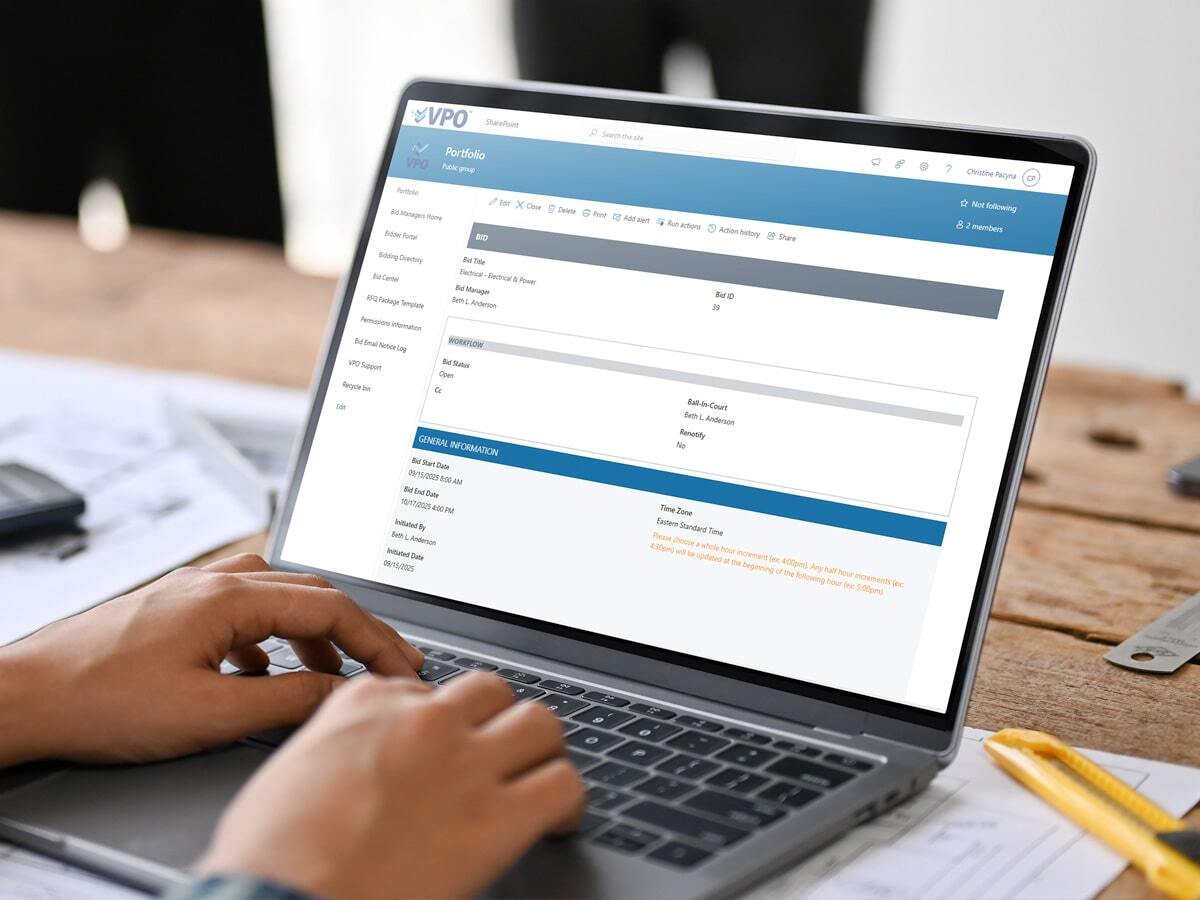
That is why a platform-based approach matters. When organizations build portfolio management on a foundation they already use and trust, like Microsoft 365, it extends existing workflows rather than creating a parallel system. Teams continue to collaborate with familiar tools like Teams, manage documents in SharePoint, and build reports with Power BI. IT teams are not asked to support something new. Instead, they work within an environment they already secure, govern, and manage.
This approach is essential for construction owners, who often need enterprise-grade capabilities without the overhead of large IT departments. That is exactly why we built VPO the way we did.
Our customers consistently tell us that IT approval is more straightforward, integration is cleaner, and support demands are lower because we are not introducing a new platform. And because VPO includes full-service administration, we help offload the IT burden from your teams.
How VPO Enables Successful Portfolio Management at Scale
In construction, everyone is ultimately working toward the same goal of delivering successful projects. At the same time, each organization brings its own systems, processes, and constraints.
VPO helps address that complexity by providing centralized governance, security, and collaboration on familiar infrastructure. Instead of relying on fragmented tools, our customers gain a unified way to manage information, workflows, and access across their entire portfolio.
The impact shows up in day-to-day operations. As one customer shared:
“With VPO, we do more with less people, take on more work, and make more money. It’s easy to use and implement, and we don’t need to add additional staff on larger projects. VPO reduces that need, adds value, and makes us more competitive.”
— Paul Buckley, Senior Vice President and Managing Director, Accenture Infrastructure & Capital Projects
Together with a platform like VPO, these four pillars
of portfolio management provide the structure needed
to support better project outcomes.
- Centralized information improves visibility
- Visibility supports consistent workflows
- Structured workflows produce reliable data
- Reliable data supports better decision-making
Having the ability to do more with the same resources becomes your organization’s competitive advantage. Our customers frequently tell us that what makes the biggest difference is not just having better tools but having a system that works the way their teams already do.
At VPO, we’ve built our platform to support that reality. By reducing manual effort, simplifying coordination, and working within trusted systems, we help teams spend more time on value-added work and less time managing the chaos.