I skipped my October post.
Not because nothing happened. Because a lot did. Some months you write about the work, and some months you’re too deep in it to step back. October was the second kind.
So consider this a four-point catch-up. There's a new role I’m incredibly proud of, a launch I’m excited about, and more.
An October Update, and a Launch
I’ll start with the launch, because it’s the one I most want you to try. Our AI-powered Contract Insights Report is live. Upload any construction contract. In minutes, you'll see the protections and constraints your team needs to manage. Plus, you'll get a free preview of your own contract before you pay a dollar.
More on why we built it, below. First, another update.
1. A New Role: President of CMAA Three Rivers
As of this month, I'm President of the Three Rivers Chapter of the Construction Management Association of America.
Professionally, this chapter means a great deal to me. I'm excited and proud to serve a group where owners and construction managers come together to raise the standards for project delivery, and to support the practice of construction management through programs in continuing education, achievement awards, and scholarships.
But this new role is also personal. My very first client, back in 2008, was our CMAA chapter's founder, Bob Wright. When I decided to raise my hand and serve our industry in my free time, there was no question where I'd volunteer. Leading the chapter that my first client started feels like coming full circle.
One thing I noticed during that experience with Bob, which I’ve seen again and again, is that the best projects happen when owners and their construction managers share the same playbook. In that spirit, and in celebration of my new role, I'm giving my fellow CMAA members a 10% discount. It's for an owner-focused course that our CCM/CACM/CMIT Committee Chair Mike McGreal and I are presenting with 28-year scheduling veteran Beth Anderson. Feel free to use the code CMAA2026 to reduce your own registration fee or to support a client in gaining insight on schedule control.
Thank you to Bob for starting it all, to Sarah Dunn for recruiting me and sharing her guidance, to Jim Cairns for leading us as Immediate Past-President, and to the officers and committee chairs I get to serve alongside. I’m looking forward to the year ahead.
2. Every Project Should Teach the Next
That’s been our belief for a long time. Every RFI, change order, meeting minute, and daily report holds a lesson about how the next project could go better. The problem has always been getting those lessons out of the folders and in front of the people making decisions.
This fall, we put that belief to work. For one of our clients, a large industrial owner, we analyzed a billion-dollar capital project and presented a lessons-learned report to their executive leadership. Years of project records, turned into clear findings an executive team could act on before their next big investment.
We’re also learning alongside some of the best minds in the field. VPO was selected as one of Carnegie Mellon’s Master of Software Engineering capstone projects this fall. In the 2026 U.S. News rankings, CMU is listed among the best in graduate computer science, and it’s right here in Pittsburgh. The CMU team is building a proof of concept to show how AI can monitor projects and flag risks earlier, using what past projects already know. I’m grateful to work with such a talented group.
Next, we’re exploring a Lessons Learned version of our AI-powered reports, so more owners can turn their own project history into guidance for the next one.
Here’s what surprised me most when we looked back at project history: so many of the lessons were written into the contract all along.
3. Signed. Filed. Forgotten.
It’s a pattern I’ve seen my whole career. The contract gets negotiated, signed, and filed. Then the team gets to work running the project...and almost nobody goes back to read it. Not because they don’t care. Because it’s hundreds of pages long, and they have a project to run.
But the contract is where the rules of the project live. How many days you have to give notice. Who has the authority to approve what. What the schedule has to include. How changes get priced. What closeout requires. When the team isn’t managing to those terms, the owner quietly gives up protection they already paid for, like a missed notice window, an approval nobody had authority to give, or a change order that didn’t have to happen. Change orders commonly run about 10% of project value, and many of them trace back to contract terms nobody was managing.
That’s the problem the AI-powered Contract Insights Report solves. It turns the contract from a document in a drawer into a plan your team can manage to. It’s live today, and it’s built for the owners we’ve always served (utilities, municipalities, and industrial owners), and the construction managers who serve them.
Here’s how it works. You upload your contract as a PDF — AIA, ConsensusDocs, CMGC, design-build, or your own custom agreement. The report reads every page against our proprietary owner-side framework, built on more than 40 years of running owner-side programs and the industry’s standards of practice. In minutes, even for a thousand-page contract, you get a one-page status summary across 11 project-setup areas, the single most important move to make on your project, practical steps tied to the clause behind each one, and the items to raise with your attorney.
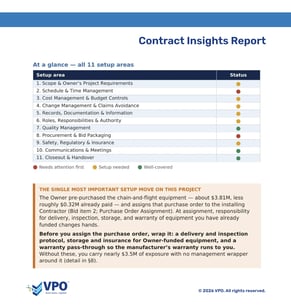
It meets you where you are. If the contract is already signed (which is most of the time) then you’ll know exactly where your exposure sits and what your team has to manage, so you can set up the notice tracking, documentation, and processes to protect the project from day one. If it hasn’t been issued yet, you can fix the risk before it’s locked in.
Built for owners, and for the CMs who serve them
Owners use it so the people running the project know what the contract actually requires. Owners’ reps and construction managers use it with their owner clients: run the report at kickoff, walk the owner through what the contract requires them to manage, and spend your billable hours on the judgment only you can provide, not on reading page 700.
Paul Buckley, CCM, says: “I reviewed the contract insight reports for four different contract types. They were consistently strong and aligned with what I would recommend as a construction manager. It's impressive that the system can produce such high-quality reports so quickly."
See it before you pay
Upload a contract and you’ll see a free preview of all 11 setup areas for your own contract before you spend a dollar. The full report is $495 per contract. No subscription, no software to install, and it works whether or not you use VPO.
Your contract stays yours. It’s used only to create your report. It's never shared, never used to train AI, and deleted after it’s processed. Not ready to upload something sensitive? Start with a public contract, or download a sample report built from a real public water-treatment contract.
For more than 40 years, our company has stood on the owner’s side. This is the first time we can put that judgment in an owner’s hands in minutes, on any contract. I’m incredibly proud of it.
4. 28 Years of Good Judgment...and Counting
Judgment like that comes from people. Around here, one of them is Beth Anderson.  Beth just celebrated her 28th anniversary with VPO. She co-created the VPO software, and has spent her career training and consulting on Primavera P6 scheduling, going back to when our company was one of the first Primavera resellers. She’s helped owners in energy and utilities, manufacturing, and higher education, to put the processes in place that keep projects on track. Scheduling isn’t a side offering for us. It’s our roots. And Beth has been here for all of it.
Beth, thank you. For your patience and precision, and for every owner you’ve helped get control of a schedule.
Now Beth is sharing what she knows in our live course, Schedule Control for Project Owners: The Contract Requirements That Reduce Construction Risk, co-teaching with a Certified Construction Manager. Most scheduling courses teach contractors how to build a schedule. This one teaches owners what to require of it: the specs to put in your contract, how to accept or reject a baseline, how to catch slippage before it becomes a claim, and how to tie payment to schedule compliance. Same idea as the report: control starts with the contract.
Wednesday, December 2, 1:00–4:00 PM ET, live online. You’ll leave with a scheduling-spec checklist, about three professional development hours, and the recording. Registration closes November 27. My fellow CMAA members save 10% with code CMAA2026.
What's Next
The next few years will reshape how owners deliver capital projects, and I’ve never been more excited to be part of it. But I’d rather show you than tell you. Pick a contract. It could be one you’re about to issue, or one you’re already living with. See what it says about your risk.
Thank you to our customers, our team, the CMU students, and everyone in this community who keeps pushing the work forward. Here's to Building Better, Together.
Laura Nee
CEO & Founder, VPO
Schedule Control for Project Owners: The Contract Requirements That Reduce Construction Risk
Learn what to require in your construction contracts, how to review contractor schedules, and how to spot slippage before it becomes a claim.
Join us live on December 2, 2026, 1-4pm ET
$795 per person · Team rates available