Construction Project Management
Best Practices for Capital Programs
Most construction project management advice is written for general contractors managing a single project at a time. It covers scheduling, subcontractor coordination, daily logs, and punch lists. That advice is useful as far as it goes.
But it does not describe the job of a capital program manager responsible for ten or fifteen simultaneous projects, a portfolio of public infrastructure, facilities, or civic buildings that have to be delivered on time, on budget, and in a way that can be reported clearly to leadership, oversight bodies, and the public.
Managing a capital program well requires a different set of practices. Not more complicated ones. Just ones that are designed for the scale and accountability requirements of the role.
This page covers the construction project management best practices that matter most at the program level, why they break down in predictable ways, and what it looks like when they are working.
What Is Construction Project Management for Capital Programs?
Construction project management for capital programs is the discipline of planning, coordinating, and controlling multiple construction projects simultaneously within a defined budget, schedule, and accountability framework.
It differs from single-project management in three important ways. First, the program manager is responsible for a portfolio of projects rather than a single job, which means decisions about resource allocation, risk prioritization, and reporting have to be made at a level above the individual project. Second, public capital programs carry accountability requirements that private projects do not, including public transparency, audit compliance, and reporting to elected officials and oversight bodies. Third, the consequences of cost and schedule problems compound across a portfolio in ways they do not on a single project.
The best practices described on this page are designed for that environment.
Why Do Capital Programs Struggle With Consistent Delivery?
Capital programs struggle with consistent delivery for a handful of reasons that appear repeatedly across public sector organizations of all sizes.
Information lives in too many places.
Each project generates communication, documentation, and financial data that tends to accumulate in separate systems: spreadsheets for budgets, email for decisions, shared drives for documents, contractor platforms for submittals and RFIs. When information is fragmented, the program manager cannot get a fast, reliable read on where things stand across the portfolio.
Reporting consumes time that should go to management.
When producing a portfolio update requires manually assembling data from a dozen separate sources, the reporting process itself becomes a significant burden. Program managers who spend twenty to forty hours a month on manual reporting are not spending that time on the early identification and management of problems.
"It's difficult to get a quick picture of where everything stands."
Problems surface late.
In programs without real-time visibility into costs and schedule, issues tend to become visible at the point where they are difficult or impossible to resolve without significant cost or delay. The window for early intervention has already closed by the time anyone knows there is a problem.
Accountability requirements are not supported by the systems in place.
Public sector capital programs are subject to audit, public records requests, grant compliance reviews, and oversight body scrutiny. Programs that rely on fragmented, manually maintained records struggle to meet these requirements efficiently and consistently.
What Are the Best Practices for Managing a Capital Program?
The following practices define what well-run capital programs do consistently and what programs that struggle tend to skip or underinvest in.
Establish a single source of truth for every project.
Every active project should have one authoritative record for its budget, schedule, change order log, RFI register, and document history. That record should be accessible to everyone who needs it and updated continuously, not maintained in parallel by multiple people in multiple formats. When the source of truth is unclear, decisions get made on outdated or conflicting information.
Track commitments, not just expenditures.
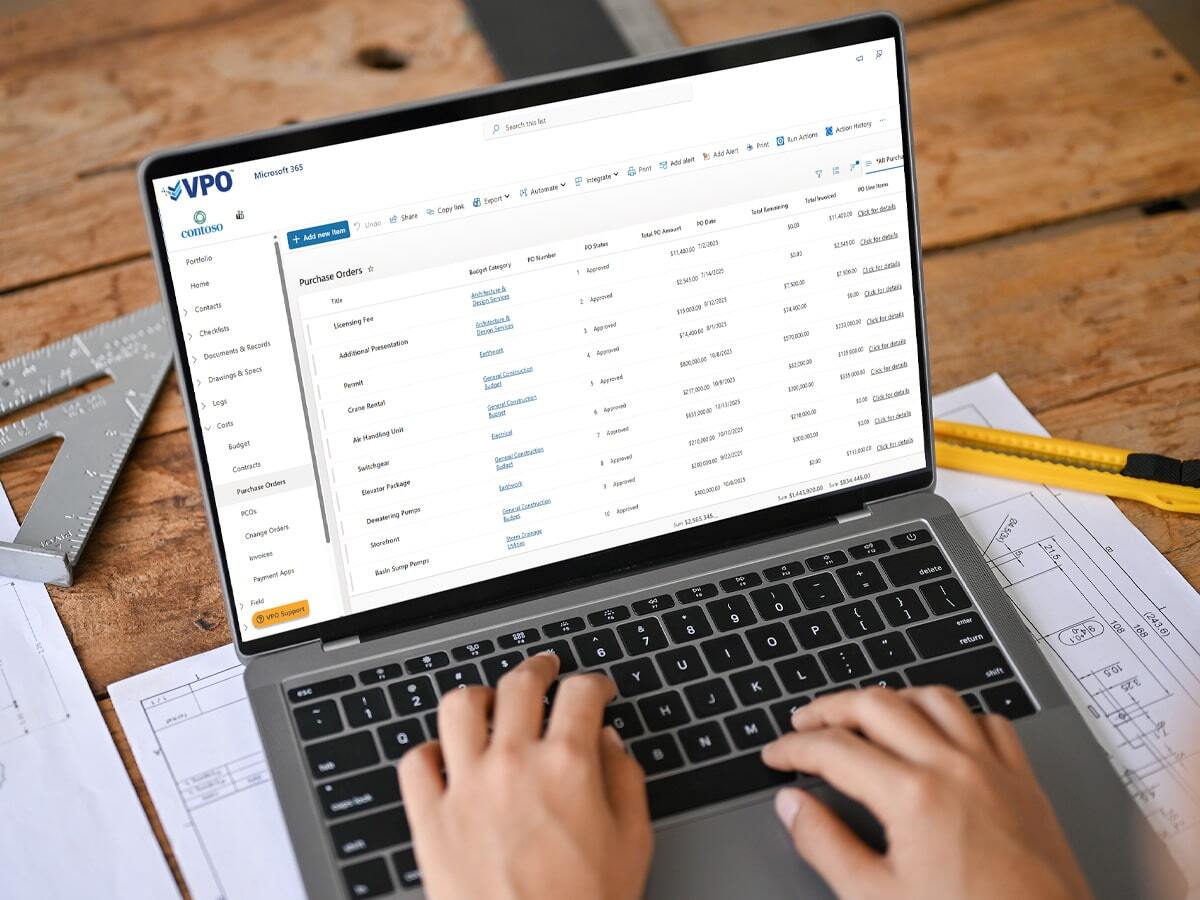
A budget that only reflects invoiced costs understates the program's true financial exposure. Every contract, purchase order, and approved change order represents a committed cost that should be reflected in the budget immediately, regardless of whether the invoice has been received. Programs that track commitments alongside actuals have a materially more accurate picture of where they stand financially.
Log change orders early and often.
Change orders should be identified and logged at the point where a potential scope change is recognized, not after the work has been done or the contractor has submitted a claim. Early logging creates the opportunity to assess cost impact, weigh options, and make decisions before the cost is committed. Late logging eliminates those options.
Connect RFI management to cost tracking.
Not every RFI becomes a change order, but many of them do. Programs that manage RFIs and budgets in separate systems consistently miss the early signals that a cost event is developing. When an RFI has a potential cost implication, that implication should be flagged and tracked against the relevant budget line item from the moment it is identified.
Maintain a live portfolio view.
The program manager needs to be able to see the financial and schedule health of every active project simultaneously, without assembling that view manually. A live portfolio dashboard that draws from the same underlying data as the individual project records is the difference between reactive management and proactive management.
Build reporting into the system, not on top of it. .
Reports should be a natural output of the project management system, not a separate product that someone has to build each time leadership asks a question. When reporting requires manually extracting, reconciling, and formatting data from multiple sources, the reporting burden grows with the portfolio and the reports themselves are never fully current.
Document decisions where the work is happening.
Decisions that drive cost and schedule changes need to be captured in a consistent, retrievable way. Not in email threads that are difficult to search. Not in meeting notes that live on someone's laptop. In a shared project record that connects the decision to the relevant contract, change order, or budget line item.
Further Reading:
Construction Documentation: What to Track, Why It Matters,
and How to Do It Well
A practical guide to construction documentation for capital programs, including what records to maintain, how to structure them, and what auditors and leadership actually need to see.
How Should a Capital Program Handle Cost Control?
Cost control in a capital program is not a single activity. It is a set of connected practices that together keep the program's financial picture accurate, current, and actionable.
The starting point is a well-structured budget with a clear baseline. Every project in the portfolio should have a budget that reflects the full approved scope, organized at a level of detail that allows meaningful variance tracking without becoming unmanageable.
From that baseline, cost control works through three ongoing activities. First, tracking every cost commitment as it is made, so the budget always reflects the program's true financial exposure rather than just what has been invoiced. Second, managing change orders proactively, identifying potential cost events early and processing them formally before the work is done rather than after. Third, forecasting the cost at completion for every active project continuously, so the program manager always knows not just where the budget stands today but where it is headed.
The reporting layer sits on top of those three activities. When the underlying data is current and connected, producing a cost report for leadership is a matter of minutes. When it is not, it is a matter of days, and the report still carries uncertainty.

Further Reading: What Is Construction Cost Management? And Why Most Programs Get It Wrong
A plain-language breakdown of what construction cost management actually involves and where most capital programs lose control of the numbers.
What Is the Role of Technology in
Construction Project Management Best Practices?
Technology does not replace good construction project management practices. It makes them easier to maintain consistently across a growing portfolio.
The specific role of technology in a well-run capital program is to connect the functions that tend to become fragmented as programs scale. Budget and financial tracking. Communication and decision documentation. Document management and version control. RFI and submittal management. Reporting and portfolio visibility.
When those functions run on separate systems, the program manager spends a disproportionate amount of time on the manual work of connecting them. When they run on a connected system, that work disappears and the program manager's time goes to actual management.
The most important criterion for evaluating construction management technology is not the feature list. It is whether the system fits how the team already works. A system that requires people to change their workflow to use it will not be used consistently, and a system that is not used consistently produces the same fragmented picture as no system at all.
Further Reading: What Is a PMIS? A Guide for Public Sector Program Managers
What a project management information system actually does, what to look for when evaluating one, and how to know when your program is ready for the transition.
What Does a Well-Run Capital Program Look Like in Practice?
A well-run capital program has a few characteristics that are visible from the outside and a few that are only visible from the inside.
From the outside, it delivers projects that come in close to the original budget and schedule, produces clear and confident reports to leadership and oversight bodies, and responds to problems quickly when they arise rather than discovering them late.
From the inside, it runs on a system where the financial picture is always current, decisions are documented in a way that supports the audit trail, change orders are managed before the cost is committed rather than after, and the program manager can answer a question about any active project without spending hours pulling files together.
The program manager is spending time on management rather than on reporting about management. The difference between those two things is the difference between a program that is running well and one that merely looks like it is.
Frequently Asked Questions
What is the difference between project management and program management in construction?
Project management focuses on the delivery of a single construction project within defined scope, budget, and schedule constraints. Program management oversees a portfolio of related projects simultaneously, with responsibility for resource allocation, portfolio-level reporting, and the organizational systems that support consistent delivery across all active projects. A capital program manager is doing both, managing individual projects while maintaining visibility and control across the entire portfolio.
What are the most important skills for a capital program manager?
The most consistently cited skills among experienced capital program managers are organizational discipline, communication clarity, financial literacy, and the ability to identify problems early. The ability to produce clear, confident reports to leadership under pressure is increasingly important as public accountability expectations have grown. Field experience, while not always required, consistently improves a program manager's ability to assess contractor performance and identify problems before they affect the budget.
How many projects can one program manager effectively oversee?
This depends heavily on project complexity, program systems, and the level of support available. Programs with connected, well-organized management systems allow one PM to oversee significantly more projects than programs running on fragmented manual processes. As a general rule, the moment a program manager cannot quickly answer basic questions about every active project without pulling files, the portfolio has grown beyond what the current system can support.
What is the biggest difference between public and private sector capital program management?
Public sector capital programs carry accountability requirements that private programs do not. These include compliance with public procurement regulations, reporting to elected officials and oversight bodies, documentation requirements for grant-funded projects, and public records obligations. These requirements raise the stakes of documentation and audit trail management significantly, and they make the quality of the underlying project management system more consequential than it is in a private sector environment.
How should a capital program handle a project that is going over budget?
The first step is identifying the overrun as early as possible, which requires a cost management system that reflects committed costs and change order activity in real time rather than at month end. Once identified, the program manager needs to assess whether the overrun can be managed within the existing contingency, whether scope adjustments are possible, and whether leadership needs to be informed and involved in the decision. The earlier the identification, the more options are available. Late identification typically leaves only one option: absorb the cost.
What is a capital improvement program?
A capital improvement program, often called a CIP, is a multi-year plan for the investment of public funds in infrastructure, facilities, and other long-lived assets. It identifies projects, prioritizes them, and allocates funding across a defined planning horizon, typically five to ten years. The capital program manager is responsible for delivering the projects within the CIP on time, on budget, and in compliance with the accountability requirements associated with public funding.
How does construction project management best practice differ for grant-funded projects?
Grant-funded projects carry additional documentation, reporting, and compliance requirements tied to the terms of the grant. This typically includes detailed cost tracking by eligible and ineligible expense categories, regular financial reporting to the granting agency, documentation of procurement processes, and audit readiness. The best practice for grant-funded projects is to establish the documentation and tracking framework at the beginning of the project rather than attempting to reconstruct it at reporting time.
What is the most common reason capital programs fail to deliver on time and on budget?
The most consistent root cause of delivery failures in capital programs is not the complexity of individual projects but the absence of reliable, current information at the program level. When the program manager cannot quickly identify which projects are at risk, where costs are trending, and what decisions are pending, problems develop further than they should before anyone responds to them. The solution is not more effort. It is a system that makes the right information available at the right time without requiring manual assembly.
How VPO Supports Construction Project Management Best Practices
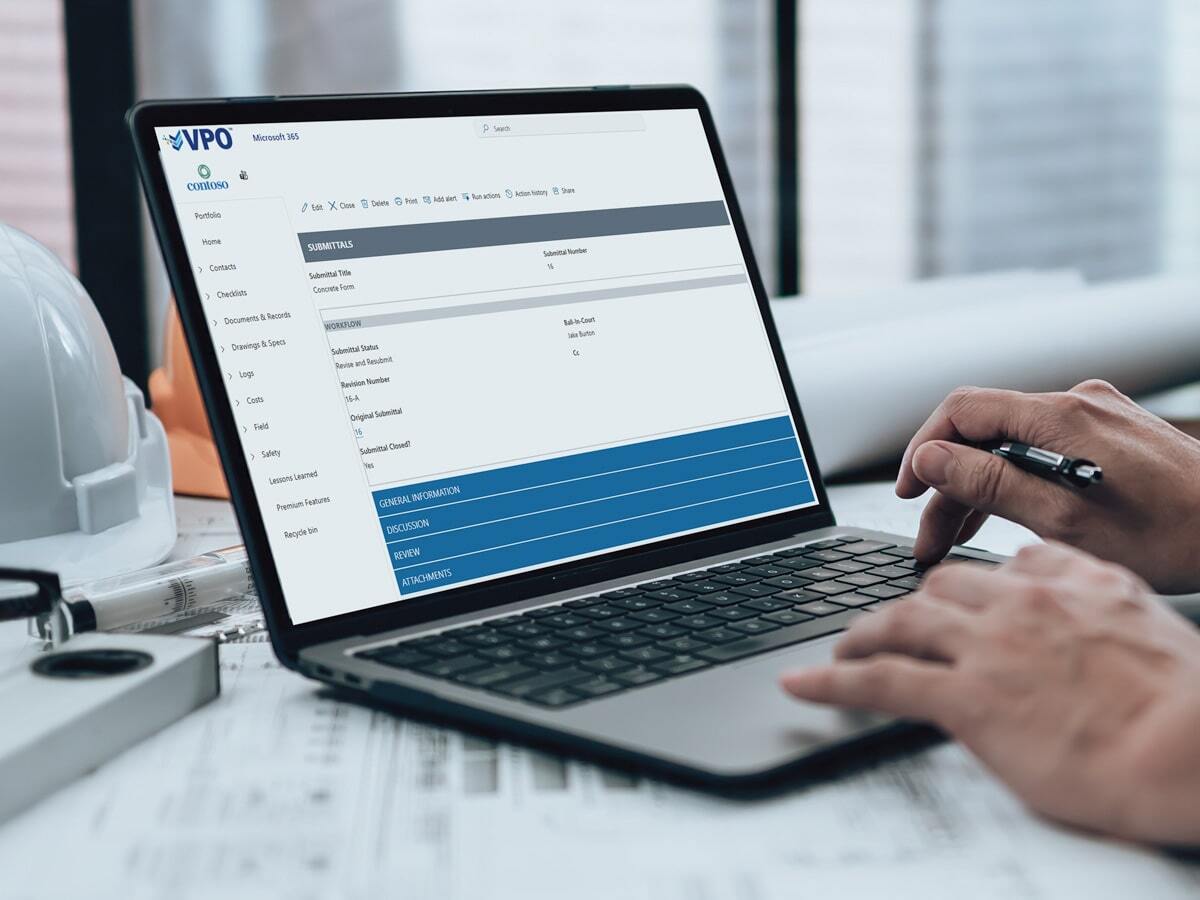
VPO is project portfolio management software built for public and private sector capital programs. It organizes communication, documents, and decisions in one place so that the best practices described on this page are supported by the system rather than working against it.
That means a single source of truth for every project. Financial tracking connected to project communication. Change orders logged and reflected in the budget as they develop. Portfolio reporting that exists continuously. And documentation that supports the audit trail without creating additional administrative work for the team.
Book a demo to see how VPO supports construction project management best practices across a capital program.